Can you play padel with 2 people?
By Lisa · padel player in 10+ countries · 1 November 2026 · 5 min read
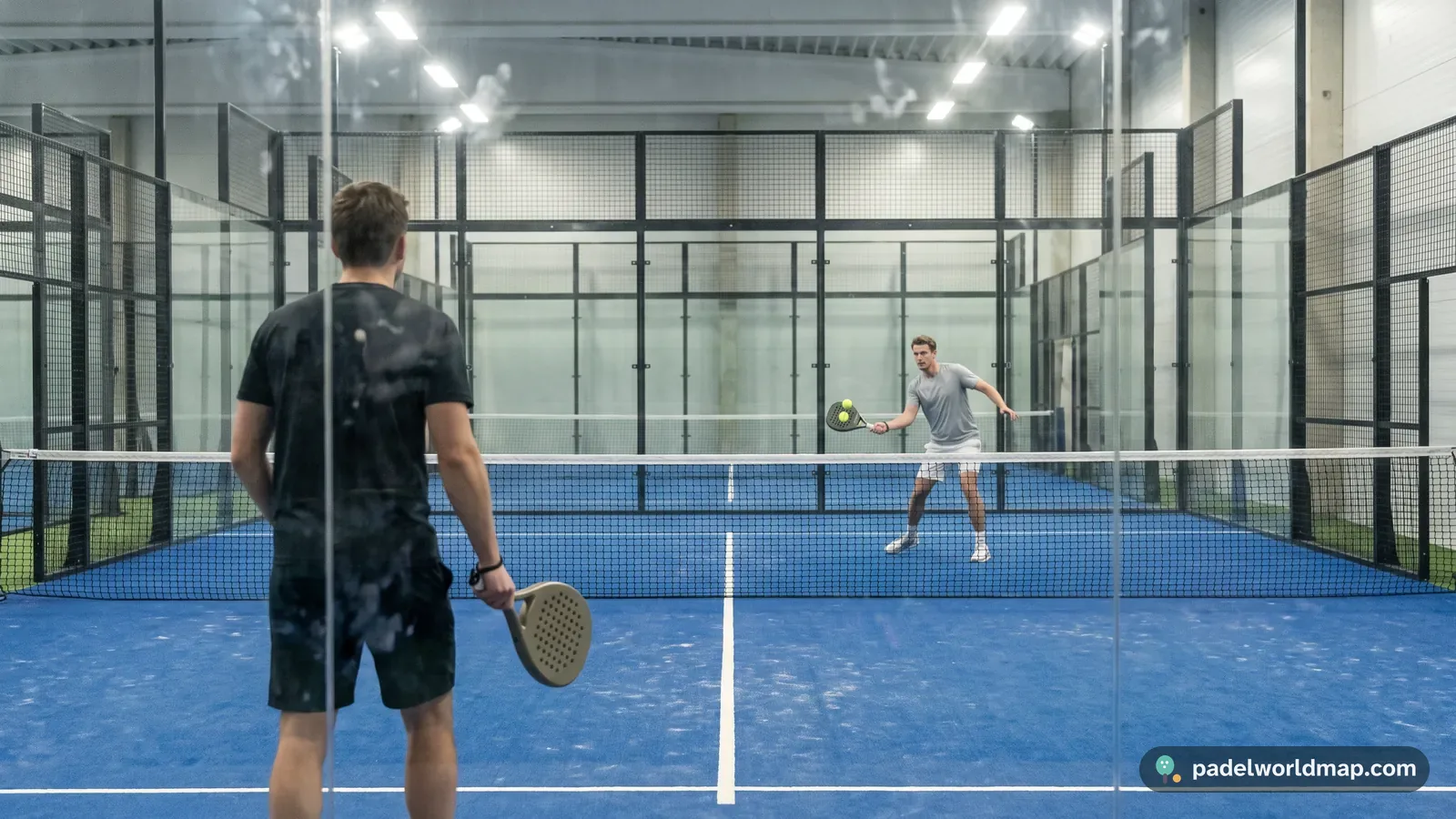
Your other two friends cancelled, but the court is booked. Can you still play? Absolutely. Padel is designed as a doubles game, but there are plenty of good ways to play with just two people.
Why padel is normally played in doubles
The official rules of the International Padel Federation (FIP) describe padel as a game between two pairs, on a court of 20 by 10 metres. With four players, two on each side, the court is covered well, rallies last longer and the walls come into play all the time. That's what makes doubles padel so social and so much fun.
With only two players on a full 10-metre-wide court, there's a lot of ground to cover on your own. That's not a problem for training, but it makes a full match very tiring and very different from normal padel.
Option 1: Singles padel on a singles court
Some clubs have special singles courts: the same length, but narrower. The UK's national federation, the LTA, describes them as 20 metres long and 6 metres wide, compared with 10 metres wide for a normal court. On a narrower court, one player can cover the width and the game keeps its padel feel, walls included.
Singles courts are still rare. The best way to find one is to ask the clubs near you; some clubs list their single courts in their description. Tap Padel near me to see the clubs closest to you, and check their pages or call them.
Option 2: Play one against one on a normal court
On a normal doubles court you can still play a proper game for two. To keep it fair and less exhausting, many players agree on a few house rules:
- Play cross-court only: both players stay in one diagonal half of the court, like the serve. The ball must land in that half.
- Use half the court: split the court lengthwise and play only on one side of the centre line.
- Normal scoring: use tennis scoring (15, 30, 40, game), or play to 11 or 21 points for a quicker game.
These aren't official rules, just popular ways to make a two-player game work. Agree on them before you start.
Option 3: Train together
Honestly, this is where two players shine. With only two of you, you each hit many more balls than in a doubles match, so it's a great way to improve. Some drills to try:
- Cross-court rallies: rally diagonally from the back of the court, focusing on control rather than power.
- Wall practice: one player feeds the ball against the back or side glass, the other learns to read the bounce and return it.
- Volley at the net: one player at the net, one at the back. Swap after every few minutes.
- Lobs and smashes: one player lobs, the other practises the overhead. Then swap.
- Serve and return: practise the underhand serve into both service boxes, with your partner returning.
Option 4: Find two more players
If you'd rather play real doubles, many clubs organise social games, open matches or level-based sessions where you can join other players. Ask at the desk or check the club's booking app. Lessons are another good way to meet people at your level; look for the Lessons pages in your town, for example padel lessons in London or in Madrid.
Good to know
- Booking: most clubs charge per court, not per player, so playing with two can cost more per person. Some clubs have cheaper single courts.
- Pace yourself: covering a full court alone is hard work. Take short breaks, especially in the heat.
- Doubles rules still apply: underhand serve, the ball must bounce in the other half before touching the walls, and you may play it off the glass after it bounces. New to the rules? Read our beginner's guide.
Curious about the exact court measurements? See padel court dimensions, or compare padel with another two-player favourite in padel vs pickleball.