Padel court dimensions: size, lines, net and walls
By Lisa · padel player in 10+ countries · 1 November 2026 · 6 min read
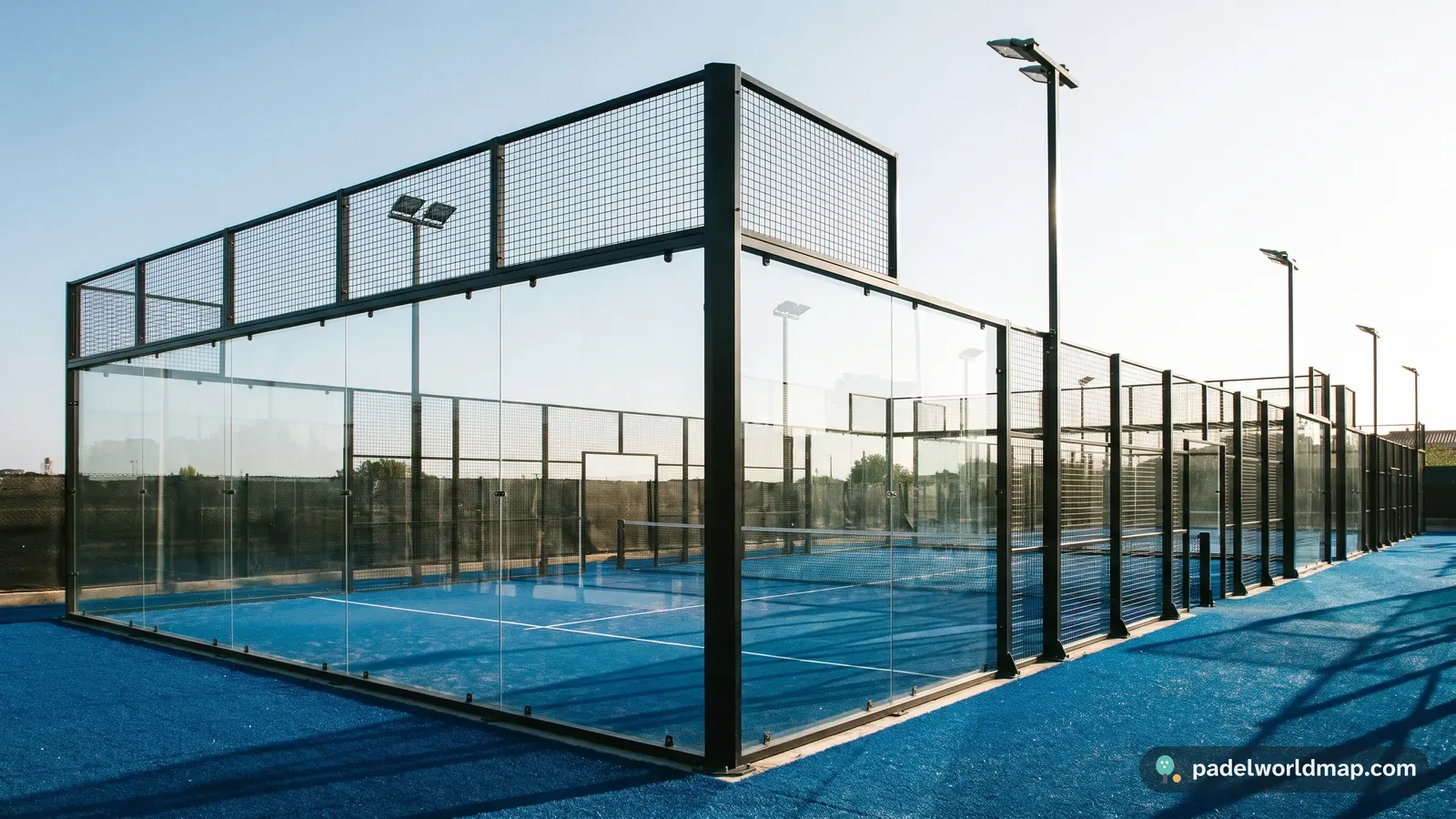
A padel court looks small next to a tennis court, but every measurement is set in the official rules of the International Padel Federation (FIP). Whether you're curious, planning to build a court or just want to understand the game better, here are the exact numbers.
The playing area: 20 × 10 metres
The court is a rectangle of 10 metres wide by 20 metres long, measured on the inside, with a tolerance of 0.5%. That's an area of 200 m², about three quarters of the lined area of a tennis doubles court.
- Service lines: 6.95 m from the net on both sides, parallel to it. That leaves 3.05 m between each service line and the back wall.
- Central service line: divides the area between the net and the service line into two service boxes, and extends at least 20 cm beyond the service line.
- Lines: all 5 cm wide, preferably white or black for contrast. Both halves must be exactly symmetrical.
The net
| Length | 10 m (the full width of the court) |
|---|---|
| Height in the middle | 0.88 m |
| Height at the ends | 0.92 m |
| Tolerance | max 0.005 m |
| Posts | max 1.05 m high |
The walls and mesh
What makes padel unique is that the court is completely enclosed, and the walls are part of the game. The rules allow two layouts, but in both the end walls are 4 metres high in total: the first 3 metres are solid wall (glass, brick or another solid material), topped by 1 metre of metal mesh.
- Side walls, layout 1: stepped walls at both ends: first a section 3 m high and 2 m long, then a section 2 m high and 2 m long. Metal mesh completes the enclosure, up to 3 m high in the central 6 metres and up to 4 m at both ends.
- Side walls, layout 2: a solid wall section without a step, with metal mesh up to 4 m high at the outer 2 metres.
- The mesh: welded diamond-shaped holes with a diagonal of 5 to 7.08 cm, made of wire of about 2 to 3 mm (maximum 4 mm), tight enough for the ball to bounce off.
The walls must give the ball an even, regular bounce. That's why most modern courts use tempered glass, which also lets spectators watch from every side.
Doors
A court has openings in the side walls so players can get in and out:
- With one opening per side: at least 1.05 × 2.00 m and at most 2.20 × 2.20 m.
- With two openings per side: each at least 0.72 × 2.00 m and at most 1.10 × 2.20 m.
If there are doors, the handles must be on the outside so they don't stick into the court.
Ceiling height for indoor courts
Lobs are a big part of padel, so indoor courts need height. The rules require a free height of at least 6 metres over the whole court, with nothing hanging into that space, and recommend 8 metres for new facilities.
How much space do you need in total?
The playing area is 20 × 10 m, but the walls and their frames add a little on every side, so the structure itself needs slightly more ground than that. Clubs that allow out-of-court play (running outside through the doors to return a ball) need a clear safety area of at least 3 metres wide (4 recommended) and 4 metres long on each side, with at least 3 metres of free height. Most indoor halls also leave walkways between courts.
Padel court vs tennis and pickleball
A tennis doubles court is 23.77 × 10.97 metres between the lines, so its lined area is only about 30% bigger than a padel court. The real difference is the run-off space: a tennis court with the room it needs around it takes up roughly three times as much ground as a padel court. A pickleball court is much smaller: 13.41 × 6.10 metres. Here are padel and pickleball side by side, to scale:
More on how the two sports compare in padel vs pickleball.
Singles courts
The official FIP rules describe the doubles court above. Some clubs also have narrower singles courts for one against one; the UK's national federation, the LTA, describes these as 20 metres long and 6 metres wide. Read more in can you play padel with 2 people?
Want to see real courts? Browse the clubs in your town, or try Spain, the country with the most padel courts on our map. If you prefer to stay dry, look for the indoor courts in your city.
Source: FIP Rules of Padel, International Padel Federation (version applying from 1 January 2026).